
An effective anti drone module for mobile defense operates in a continuous, tightly integrated cycle: detect, track, neutralize. Detection combines radar, RF scanning, and electro-optical sensors to identify unauthorized drones across complex environments—especially critical where visual line-of-sight is limited or RF clutter is high. Once detected, the system tracks the drone’s position, velocity, and heading in real time, feeding fused data into a compact command-and-control interface—either handheld or vehicle-integrated. Neutralization follows via precision RF jamming or GPS spoofing, targeting common control and navigation bands (2.4 GHz, 5.8 GHz, GPS L1/L2) without affecting friendly systems. Field evaluations by NATO’s Joint Counter-UAS Centre of Excellence show end-to-end engagement times under five seconds for optimized mobile configurations—providing decisive advantage against fast, low-altitude threats.
Mobile defense units operate across shifting mission sets—from dismounted patrols to armored convoy escort—and cannot afford platform-specific hardware silos. True modularity enables seamless swapping of detection sensors (e.g., switching from wide-area radar to directional RF sniffers), jamming modules (band-specific or multi-band), and power systems (vehicle tap vs. swappable lithium packs), all through a standardized mechanical and data interface. This reduces reconfiguration time from hours to under two minutes and eliminates redundant training and spare-part inventories. As documented in the U.S. Army’s Counter-Unmanned Aircraft Systems (C-UAS) Field Manual FM 3-01.9, modular architecture directly supports “plug-and-fight” doctrine—ensuring one operator can deploy the same core system across a Humvee, MRAP, or backpack without requalification.
Mobility defines physical boundaries: vehicle-mounted modules leverage host-platform resources—drawing 10–30 W from alternators, supporting larger antennas and multi-sensor fusion—enabling detection ranges up to 3 km and simultaneous multi-drone engagement. In contrast, man-portable modules must weigh ≤2 kg, run on internal batteries, and deliver 5–10 W output. These constraints reduce effective range (typically <1 km) and narrow frequency coverage—but prioritize immediacy and concealment. Crucially, range and power are not linear trade-offs: modern adaptive jamming algorithms in compact modules (e.g., those validated under UK MoD’s Project MUSKET) maintain 85% neutralization efficacy at 800 m despite lower peak power, thanks to intelligent signal prioritization and dwell-time optimization.
In mobile operations, “time from stop to coverage” is the definitive performance metric—not theoretical setup time in lab conditions. Handheld modules achieve full operational readiness in under 60 seconds: unbox, mount on tripod or weapon rail, power on, and confirm status. Vehicle-mounted systems require mast elevation, antenna alignment, and software handshake—but modular rack-mount designs with auto-calibrating inertial reference units cut activation to under 90 seconds. Real-world testing during U.S. Marine Corps Exercise Steel Knight demonstrated that systems with one-button activation and pre-stored geo-fenced profiles reduced average deployment latency by 42% compared to manual configuration—critical when responding to swarm incursions during convoy halts or checkpoint breaches.
Mobile anti drone modules endure environmental extremes that test engineering integrity: desert convoys expose electronics to sustained 70°C ambient heat and rapid thermal cycling; Arctic patrols demand cold-start reliability below –40°C and resistance to condensation-induced short circuits. Effective thermal management uses passive heatsinks with phase-change materials—not just fans—to avoid moving parts failure. Electromagnetic hardening must meet MIL-STD-461G requirements for radiated and conducted emissions, shielding against interference from vehicle alternators, radios, and nearby radar—validated in live-force exercises like Germany’s Joint Air Defence Exercise. Weather resistance isn’t optional: IP66-rated enclosures (not just IP65) prevent ingress during sandstorms, heavy rain, or submersion in shallow fording—per NATO AEP-97 standards for field-deployable C-UAS equipment.
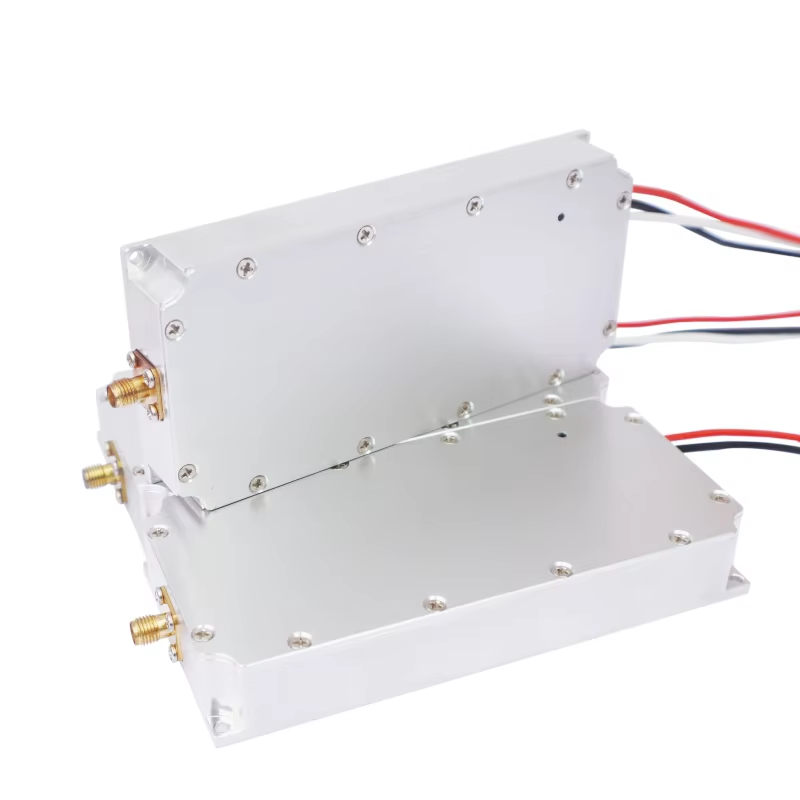
Use-case validation determines whether a specific anti drone module delivers reliable performance for your particular defense situation. Real-world scenarios place very distinct demands on counter-drone capabilities—an evaluation focused purely on abstract technical specifications risks overlooking critical deployment realities.
A mobile desert convoy faces UAV threats optimized for speed and low observability, with detection hampered by dust, heat haze, and limited terrain masking. Its anti drone module must prioritize RF-based detection over EO, feature rapid threat classification to filter false positives from ground clutter, and sustain operation in extreme heat without active cooling. By contrast, urban perimeter defense contends with dense RF noise, multipath reflections, and close-proximity threats—requiring high-resolution direction-finding, narrow-beam jamming to avoid collateral disruption, and integration with existing CCTV or access-control systems. As outlined in the UK Ministry of Defence’s C-UAS Operational Guidance Note, successful selection begins with mapping threat vectors, environmental stressors, and response timelines—not comparing datasheets in isolation.
Operators facing hostile drone incursions require systems engineered for human performance under duress. Complex menus, ambiguous status indicators, or multi-step engagement sequences increase cognitive load and delay action—especially when fatigued, stressed, or operating in degraded conditions. Research from the U.S. Naval War College shows that interfaces requiring 3 button presses or 2 seconds of visual scanning before confirmation increase average engagement latency by 1.7 seconds—enough for a small UAV to enter lethal range. High-performing modules use intuitive, context-aware UIs: color-coded threat rings, voice-prompted status updates, and single-action neutralization toggles—all designed around NATO STANAG 4586 human-system integration principles. Ultimately, no module is effective if its design undermines the operator’s ability to act decisively.
Anti drone modules primarily perform detection, tracking, and neutralization. Detection identifies drones using radar, RF scanning, and electro-optical sensors. Tracking monitors the drone's real-time position, velocity, and heading. Neutralization employs RF jamming or GPS spoofing to disable the drone.
Modularity allows for interchangeable components, such as detection sensors, jamming modules, and power systems. This flexibility supports rapid reconfiguration, reduces training and maintenance costs, and improves operational efficiency across different platforms.
Vehicle-mounted modules utilize platform resources, providing greater range and power for multi-drone engagement. Man-portable models are lightweight, battery-powered, and prioritize mobility and immediacy, although they have reduced range and frequency coverage.
Modules must endure extreme conditions, such as high heat, cold, condensation, and electromagnetic interference. Effective designs incorporate thermal management, EMI hardening, and weather resistance to ensure reliability in various environments.
High-performing modules use intuitive interfaces, such as color-coded threat indicators and voice prompts, to reduce cognitive load. Simplified controls and automation minimize delays and support quick decision-making under high-pressure scenarios.

Shenzhen Longyuan Technology provides intelligent counter-drone systems for airports, stadiums & critical infrastructure. Real-time RF detection, tracking, and jamming with high-gain antennas and custom solutions. Trusted by global security teams.
Building A,Kaishangde Industrial Park,No. 1 Xinghua Road, Pingdi Sub-district, Longgang District, Shenzhen City
Copyright © 2026 Shenzhen Longyuan Technology Co., Ltd. All rights reserved. Privacy Policy
 EN
EN



 Hot News