
Unauthorized drone flights near sensitive sites have escalated from nuisance to proven security hazards. During the 2018 Gatwick Airport incident, rogue drone sightings grounded over 1,000 flights and caused an estimated $75 million in delays and diversions. In 2020, a drone crashed next to a U.S. electrical substation—the first confirmed intentional targeting of civilian energy infrastructure by an Unmanned Aerial System (UAS). The United Kingdom recorded over 400 security concerns at civil nuclear sites in 2021—a 30% increase from the prior year—many involving drone incursions. These events demonstrate that a single rogue drone can disrupt critical operations, damage assets, and compromise public safety with minimal effort.
Commercial off-the-shelf drones are lightweight, highly maneuverable, and widely available. Their small size and low-altitude flight paths allow them to bypass traditional perimeter security, such as fences and ground sensors. Attackers can easily modify these drones to carry explosives, conduct covert surveillance, or launch coordinated swarm incursions. Because drone interference often exploits the vulnerability gap between detection and mitigation, operators of power plants, water treatment facilities, and government sites must address these blind spots. The stakes extend beyond immediate physical damage: service disruptions erode public trust and ripple through the broader economy.
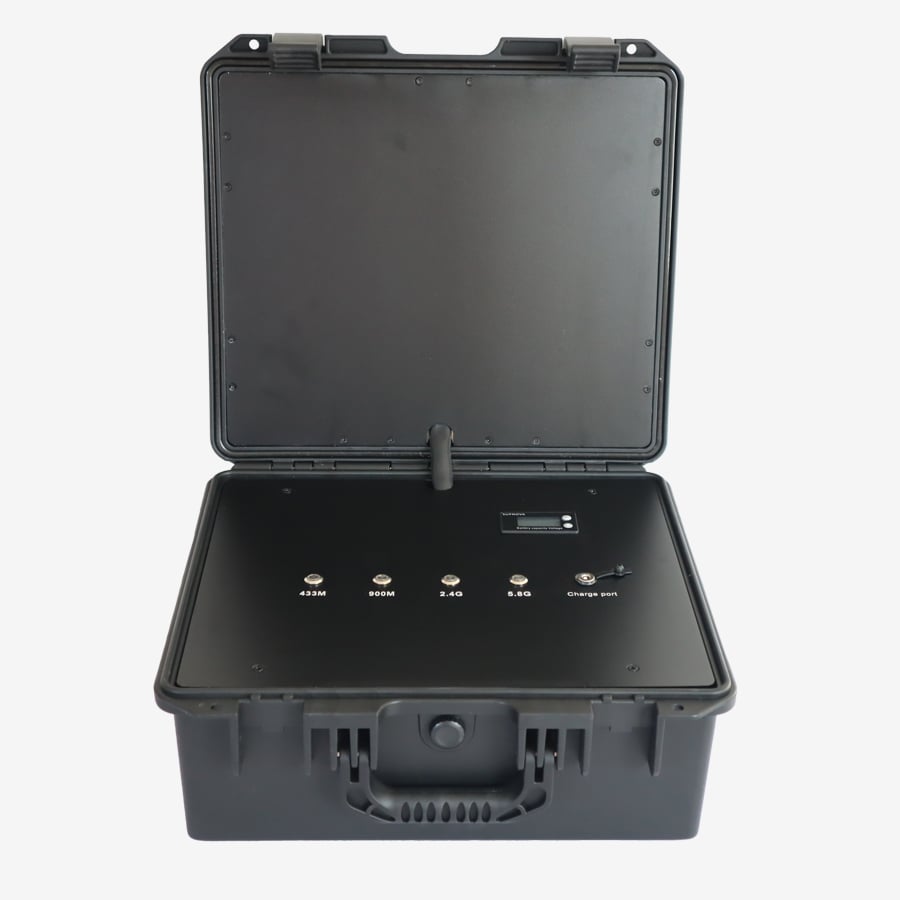
Electronic counter-drone technologies employ distinct methods for neutralizing threats. RF jamming disrupts drone communication signals by broadcasting radio frequency noise, causing immediate loss of control. GNSS spoofing deceives drone navigation systems by transmitting false GPS coordinates, redirecting drones harmlessly. Cyber takeover exploits software vulnerabilities to hijack drone control systems. Each method carries unique operational risks: RF jamming risks collateral signal disruption, GNSS spoofing requires precise positioning, and cyber takeover depends on exploitable firmware weaknesses. Safety protocols must prioritize minimizing unintended consequences while maintaining airspace integrity.
Operators must navigate complex regulatory frameworks when deploying counter-drone technologies. The Federal Communications Commission (FCC) prohibits unauthorized signal jamming under 47 CFR § 15.5, with limited exceptions for federal agencies. The National Telecommunications and Information Administration (NTIA) coordinates spectrum allocation for authorized systems, while Department of Homeland Security (DHS) directives govern security operations near critical infrastructure. Legal drone interference requires either federal agency authorization or compliance with emerging legislative frameworks like the FAA's UAS Mitigation Waiver Program. Violations can incur penalties exceeding $100k per incident.
Urban environments present unique challenges for drone interference systems due to signal-blocking structures and dense RF noise. Concrete buildings create non-line-of-sight (NLOS) conditions that disrupt jamming effectiveness, while competing signals from Wi-Fi networks and cellular towers increase false positives. Effective countermeasures require:
These techniques reduce collateral disruptions to legitimate communications by confining interference to defined operational zones. Field tests show directional systems lower signal bleed by up to 78% compared to omnidirectional approaches in dense urban settings.
Recent FCC field evaluations demonstrate how phased-array antennas and adaptive null-steering technologies minimize off-target effects during drone interference operations. Key findings include:
| Technique | Collateral Reduction | Operational Impact |
|---|---|---|
| Beamforming | 62–78% | Maintains critical infrastructure communications |
| Frequency-hopping jamming | 45–67% | Preserves emergency responder channels |
| Power-cycling protocols | 51–73% | Reduces civilian device disruption |
The data reveals that intermittent jamming pulses lasting under 200 milliseconds effectively neutralize drones while allowing legitimate signals to transmit during interference gaps. These methods prove particularly valuable near hospitals and airports where constant communication must be preserved. Field operators confirm that combining these approaches creates layered protection against rogue drones while maintaining essential wireless services.
Rogue drones refer to unmanned aerial systems (UAS) used without authorization, often posing threats to critical infrastructure, public safety, or security.
Yes, attackers can modify commercial drones to carry explosives, conduct surveillance, or execute coordinated attacks, making them a significant security risk.
Technologies like RF jamming, GNSS spoofing, and cyber takeovers can neutralize rogue drones by disrupting their communication, navigation, or control systems.
Counter-drone technologies must comply with regulations from agencies like the FCC, NTIA, and DHS, and often require federal authorization to operate legally.
Minimizing collateral impact ensures that legitimate communication channels, especially near hospitals and airports, remain functional during drone interference operations.

Shenzhen Longyuan Technology provides intelligent counter-drone systems for airports, stadiums & critical infrastructure. Real-time RF detection, tracking, and jamming with high-gain antennas and custom solutions. Trusted by global security teams.
Building A,Kaishangde Industrial Park,No. 1 Xinghua Road, Pingdi Sub-district, Longgang District, Shenzhen City
Copyright © 2026 Shenzhen Longyuan Technology Co., Ltd. All rights reserved. Privacy Policy
 EN
EN


 Hot News