
Navigating drone interference requires strict adherence to federal regulations to ensure airspace safety and compliance. In the United States, the Federal Aviation Administration (FAA) maintains exclusive jurisdiction over national airspace, classifying drones as aircraft subject to stringent operational rules. Unauthorized physical or electromagnetic interference—including signal jamming or forced landings—violates federal law and risks severe penalties. Individuals cannot unilaterally disable or destroy drones, even on private property, as this constitutes illegal interference with aircraft operations. Consequences include substantial fines under FAA enforcement actions and potential criminal charges for endangering aviation safety. Permissible countermeasures focus on non-destructive methods like geofencing integration and LAANC-approved flight restrictions. Understanding this regulatory framework helps stakeholders avoid legal liability while implementing compliant drone mitigation strategies.
Geofencing is the most passive and widely accepted method of drone interference, relying on pre-programmed virtual boundaries within the drone’s flight controller rather than any active signal emission. When a drone approaches a no-fly zone, the geofence triggers an automated response—typically forcing the aircraft to hover, land, or return to its launch point—without emitting any disruptive energy that could affect other electronic systems. This approach is inherently safe because it operates entirely on the drone’s own navigation logic, making it reversible: once the drone exits the restricted area, normal control resumes. However, geofencing depends entirely on the drone manufacturer’s database accuracy and the operator’s decision to keep firmware updated. It cannot stop a drone that has been deliberately modified to disable its geofence or that is flying under manual control with spoofed coordinates. Therefore, while geofencing is an excellent first-line compliance tool, it is insufficient for high-security environments where active threats must be neutralized.
For scenarios requiring active intervention, two non-physical methods dominate: RF-based cyber takeover and GNSS spoofing. RF cyber takeover works by passively detecting the drone’s control link, identifying its protocol, and sending authenticated commands to take control of the aircraft. Because it uses the drone’s own communication channel, the takeover is precise and reversible—the legitimate operator can regain control after the threat passes. GNSS spoofing, by contrast, broadcasts counterfeit satellite signals to trick the drone into believing it is elsewhere, causing it to drift or land inadvertently. While both methods avoid physical destruction, GNSS spoofing carries higher collateral risks: false signals can leak beyond the intended target, interfering with nearby GPS-dependent devices like cell towers, emergency services, and other aircraft. From a regulatory perspective, RF cyber takeover is generally favored for urban and critical-infrastructure use because it is surgical and does not disrupt the broader electromagnetic environment. GNSS spoofing, if used at all, requires strict power calibration and fallback protocols to prevent unintended navigation failures. The table below summarizes key trade-offs.
| Technique | Mechanism | Reversibility | Collateral Risk | Regulatory Acceptance |
|---|---|---|---|---|
| RF Cyber Takeover | Protocol exploitation | Full (operator can reassert control) | Minimal (targets only the drone) | High (preferred for dense areas) |
| GNSS Spoofing | False satellite signals | Partial (drone may ignore if using inertial backup) | High (affects nearby GNSS receivers) | Low (requires strict safeguards) |
Operational planners should prioritize RF cyber takeover for civilian settings and reserve GNSS spoofing only for remote or approved test ranges where spillover can be contained. Both methods remain viable under proper legal authorization, but their deployment must align with local aviation authority guidelines to avoid violating communications regulations.
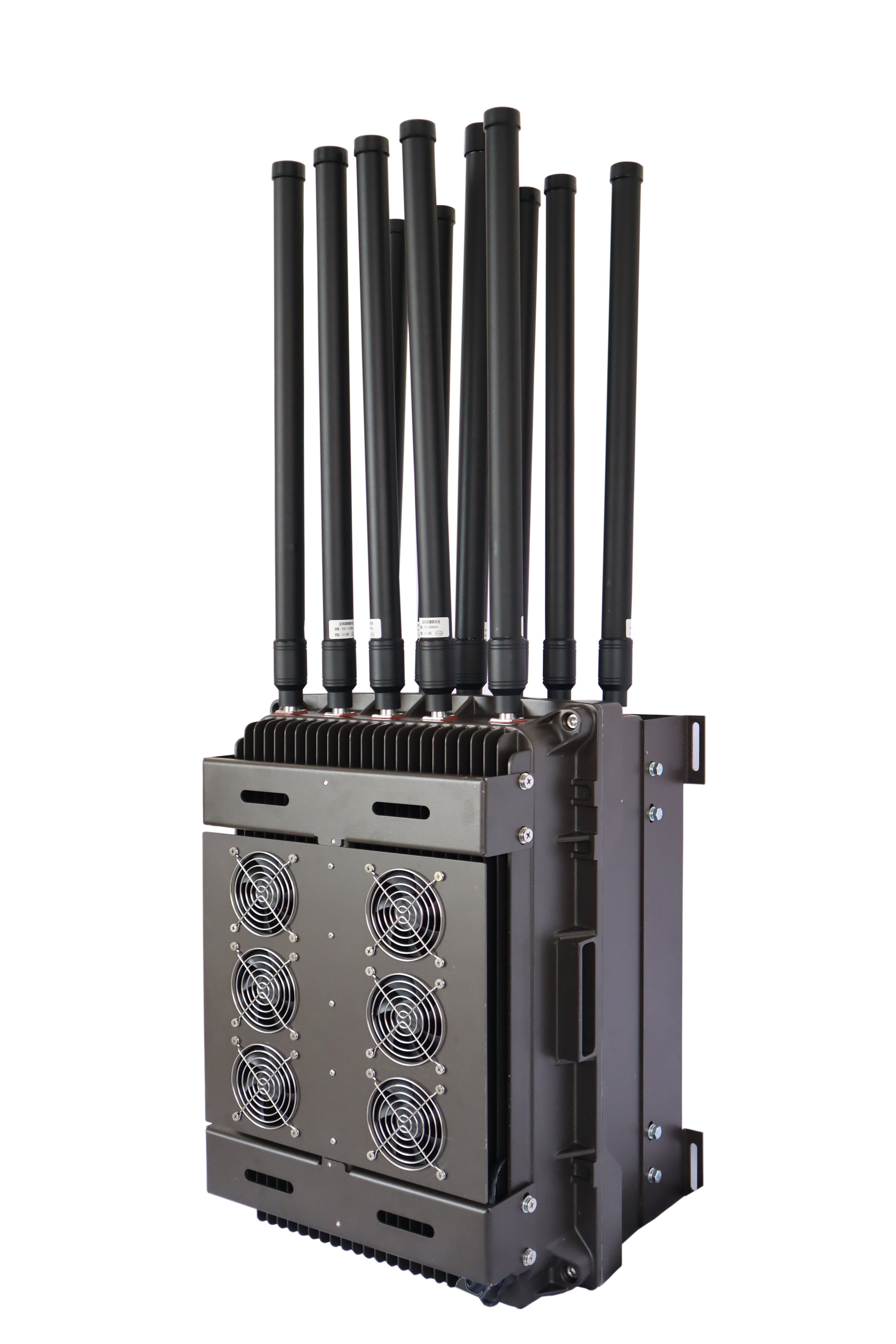
Using physical or electromagnetic methods to stop a drone carries serious risks. Interfering with a drone’s control or navigation signals can cause collateral damage, such as disrupting nearby electronics or creating safety hazards for people on the ground. Urban environments amplify these challenges because dense wireless traffic, reflective surfaces, and infrastructure create unpredictable interference paths. Mitigation strategies must account for these complexities to avoid unintended consequences.
Electromagnetic interference (EMI) originates from common sources such as high-frequency switching drives, radio transmitters, and power distribution equipment. In cities, the concentration of these sources makes it difficult to target only the rogue drone without affecting legitimate communications. The FAA sets safety thresholds for radio frequency exposure to protect human health and device integrity. Any electromagnetic drone interference method must operate within those limits to remain legally permissible. Shielding, filtering, and careful frequency selection help reduce risks, but they cannot eliminate the unpredictability of dense urban electromagnetic environments. Deployment teams must conduct site surveys and pre-authorization checks before activating any EMI-based countermeasure.
Only approved federal agencies can legally perform active drone interference in the U.S. The FAA Reauthorization Act of 2018 granted this authority to secure critical infrastructure against hostile drones. However, most non-federal entities lack the legal power to jam or spoof drone signals without significant risk of violating the Wiretap Act or the Pen/Trap statute.
The FAA provides authorization through two key channels. The first is a formal C-UAS (Counter-Unmanned Aircraft System) waiver, which allows specific agencies to deploy active interference tools like RF jamming or GNSS spoofing. The second is the LAANC (Low Altitude Authorization and Notification Capability) system, which grants instant flight permissions in controlled airspace but does not authorize interference. A clear precedent exists: when a drone delayed firefighting aircraft near an active wildfire, the response required FAA coordination before any mitigation could occur. Operating without these safeguards exposes entities to serious legal consequences.
No, individuals cannot legally disable or destroy drones, even over private property, as it constitutes illegal interference with aircraft operations under federal law.
Geofencing creates virtual boundaries that automatically restrict drone operations in no-fly zones without emitting disruptive signals, making it a safe and non-destructive compliance tool.
RF cyber takeover uses the drone’s control link to take precise, reversible control, while GNSS spoofing broadcasts false satellite signals, posing a higher risk of collateral interference.
Only approved federal agencies can conduct active drone interference activities, such as jamming or spoofing, under FAA guidelines and legal waivers.
Unauthorized interference can lead to severe fines, potential criminal charges, and regulatory violations, including those outlined under the Wiretap Act and FAA enforcement actions.

Shenzhen Longyuan Technology provides intelligent counter-drone systems for airports, stadiums & critical infrastructure. Real-time RF detection, tracking, and jamming with high-gain antennas and custom solutions. Trusted by global security teams.
Building A,Kaishangde Industrial Park,No. 1 Xinghua Road, Pingdi Sub-district, Longgang District, Shenzhen City
Copyright © 2026 Shenzhen Longyuan Technology Co., Ltd. All rights reserved. Privacy Policy
 EN
EN


 Hot News